Rietveld refinement
Rietveld refinement is a method for refining crystal structures from X-ray and neutron powder diffraction data. Originally developed by Hugo Rietveld in 1969, it’s now a staple in materials science for analyzing crystalline phases. The method works by modeling an entire diffraction pattern using known structural parameters, which are then adjusted to minimize the difference between the observed and calculated data.
Basic Usage with CubicModel
The following example demonstrates a basic refinement workflow using the built-in CubicModel and the RefinementWorkflow class:
import powerxrd as xrd
from powerxrd.model import CubicModel
import powerxrd.refine as rr

model = CubicModel()

# Load and preprocess synthetic data
x_exp, y_exp = rr.load_data("synthetic-data/sample1.xy")
x_exp, y_exp = xrd.Chart(x_exp, y_exp).backsub()

# Define starting parameters
model.params = {
    "a": 6.0,
    "U": 0.005,
    "W": 0.005,
    "scale": 1000.0,
    "bkg_slope": 0.0,
    "bkg_intercept": 0.0
}

rw = xrd.RefinementWorkflow(model, x_exp, y_exp)
rw.refine(['scale'])        # Stage 1: refine scale
rw.plot_fit()

rw.refine(['a', 'U', 'W'])  # Stage 2: refine lattice + profile
rw.plot_fit()
rw.save_log('my_stages.json')
This modular API is still under active development and currently supports only cubic systems — we’re keeping it simple for now.
Getting Started: hello_rietveld.py
For new users, we recommend starting with the hello_rietveld*.py scripts located in the root directory.
These examples walk through a Minimum Viable Rietveld (MVR) refinement: - Load synthetic XRD data - Apply background subtraction - Initialize a CubicModel - Refine a single parameter (e.g., scale) - Plot the fit against experimental data
Refinement Example
Below is the output from a minimal refinement session using the hello_rietveld_long.py workflow. It shows both:
The experimental vs. refined pattern (left plot)
The live parameter optimization and fit statistics (right terminal)
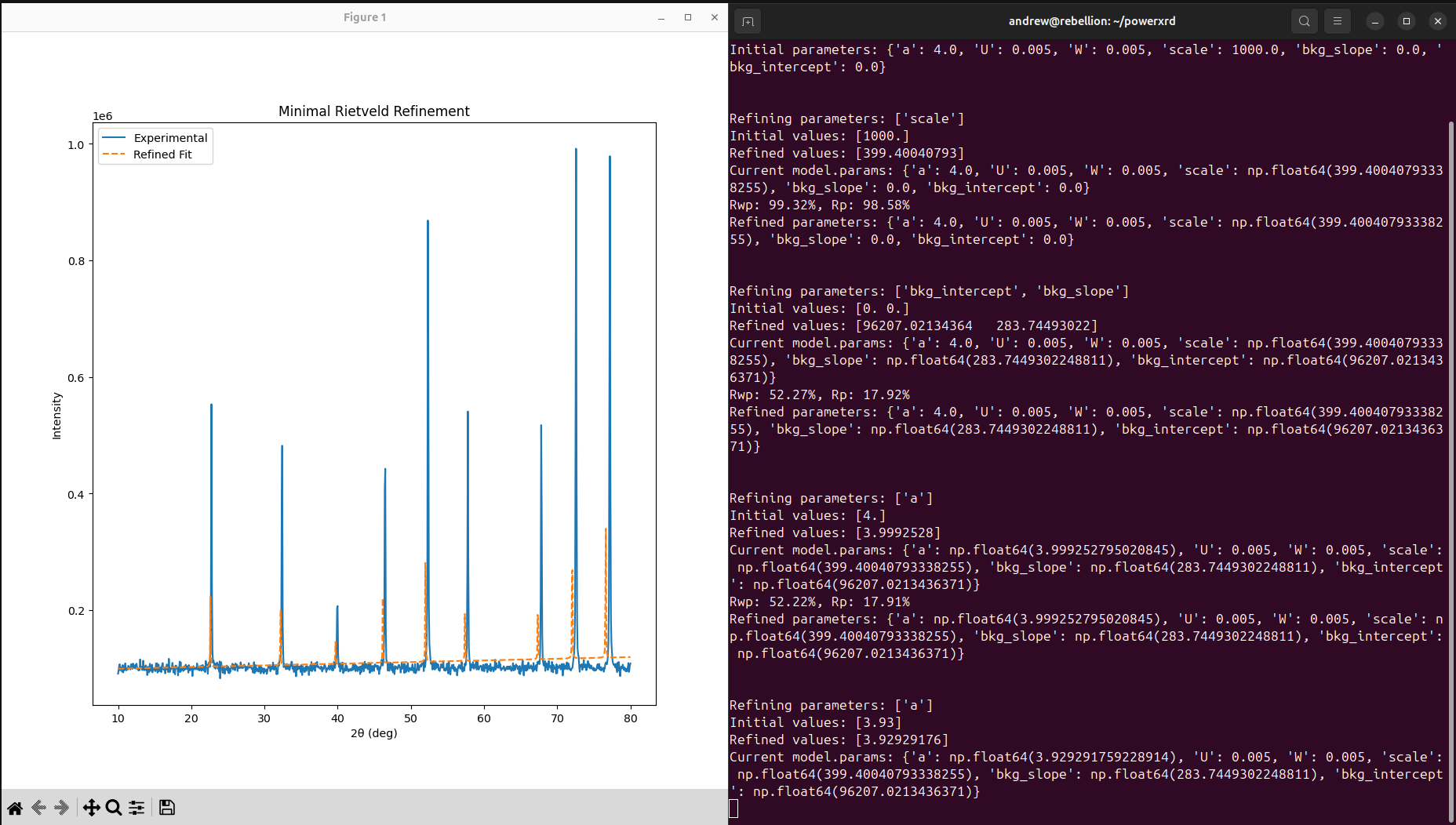
This run used just a handful of parameters — initially refining only scale, then adding a, U, W, and background terms. Despite the simplicity, the fit successfully reconstructs synthetic XRD data using a CubicModel.
Want to try it yourself? Run:
python examples/hello_rietveld_long.py
For more extensive workflows, see the Usage section — or check out the YouTube tutorials (no TikTok, we promise).
Note
These scripts are not meant for publication-grade results. They’re meant to be clicked, read, broken, and learned from.
Literature
Rietveld, H.M. (1969), A profile refinement method for nuclear and magnetic structures. J. Appl. Cryst., 2: 65-71. https://doi.org/10.1107/S0021889869006558
FullProf : Rietveld, Profile Matching & Integrated Intensities Refinement of X-ray and/or Neutron Data (powder and/or single-crystal). Link: https://www.ill.eu/sites/fullprof/
Flores-Cano, D. A., Chino-Quispe, A. R., Rueda Vellasmin, R., Ocampo-Anticona, J. A., González, J. C., & Ramos-Guivar, J. A. (2021). Fifty years of Rietveld refinement: Methodology and guidelines in superconductors and functional magnetic nanoadsorbents. Revista De Investigación De Física, 24(3), 39-48. https://doi.org/10.15381/rif.v24i3.21028
Ozaki, Y., Suzuki, Y., Hawai, T., Saito, K., Onishi, M., & Ono, K. (2020). Automated crystal structure analysis based on blackbox optimization. npj Computational Materials, 6(1), 75. https://doi.org/10.1038/s41524-020-0330-9
Rietveld Refinement for Macromolecular Powder Diffraction Maria Spiliopoulou, Dimitris-Panagiotis Triandafillidis, Alexandros Valmas, Christos Kosinas, Andrew N. Fitch, Robert B. Von Dreele, and Irene Margiolaki Crystal Growth & Design 2020 20 (12), 8101-8123 DOI: 10.1021/acs.cgd.0c00939
The Rietveld Refinement Method: Half of a Century Anniversary Tomče Runčevski and Craig M. Brown Crystal Growth & Design 2021 21 (9), 4821-4822 DOI: 10.1021/acs.cgd.1c00854
Diffraction Line Profiles in the Rietveld Method Paolo Scardi Crystal Growth & Design 2020 20 (10), 6903-6916 DOI: 10.1021/acs.cgd.0c00956